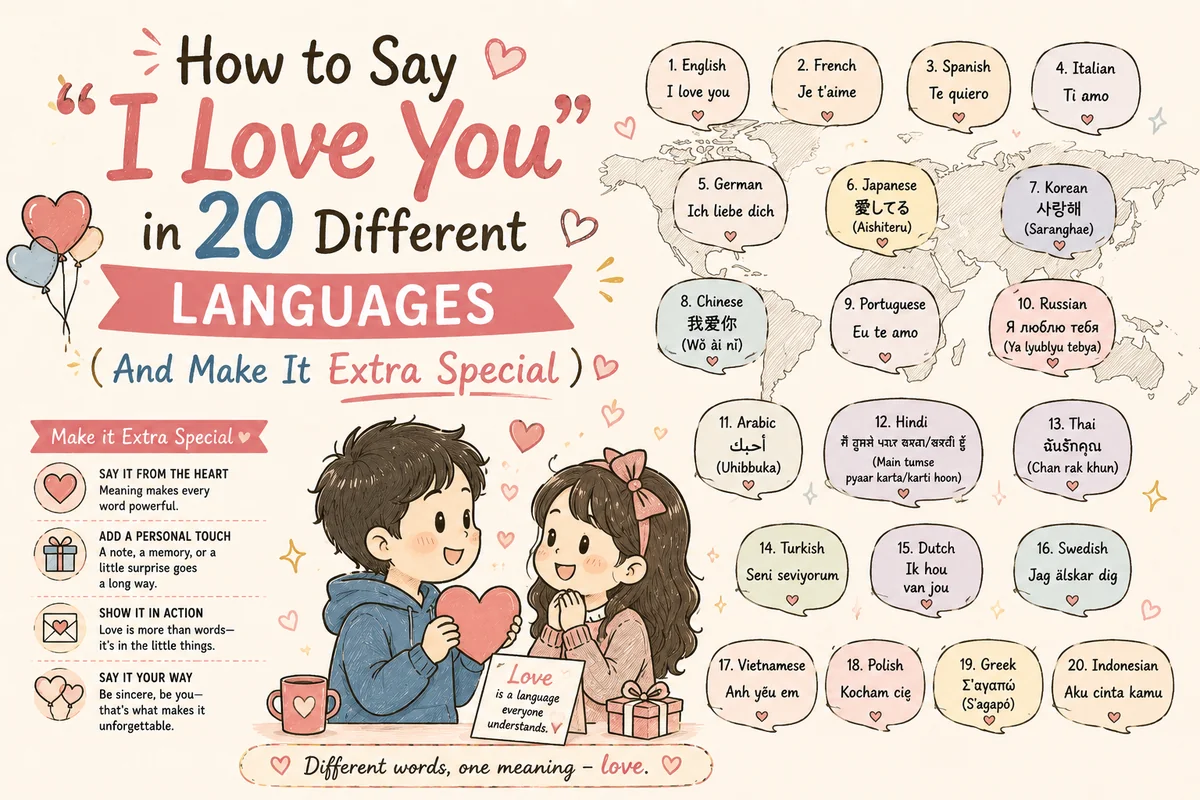
How to Say “I Love You” in 20 Different Languages (And Make It Extra Special)
There’s something a little magical about hearing “I love you” in a language that isn’t your own. Maybe it’s the way the words feel unfamiliar on your tongue, or the tiny thrill of learning that half the world has its own way of saying the same beautiful thing.
In multicultural Singapore, we’re surrounded by languages every single day — English, Mandarin, Malay, Tamil, Hokkien, and the delightful rojak of Singlish that ties it all together. So whether you’re planning a romantic surprise, writing a message for someone special, or you just love a good bit of language trivia, here are 20 ways to say those three little words.
The Classics You Probably Know
1. English — “I love you.” Simple, timeless, never goes out of style.
2. Mandarin Chinese — “我爱你” (Wǒ ài nǐ). Fun fact: many Chinese couples say “520” (wǔ èr líng) as a code for “I love you,” because the numbers sound similar to the phrase. May 20th (20/5) has even become an unofficial romance day.
3. Malay — “Aku cinta kamu” or the softer “Aku sayang kamu.” Sayang is one of those beautiful words that means love, affection, and “darling” all at once.
4. Tamil — “நான் உன்னை காதலிக்கிறேன்” (Naan unnai kaadhalikiren).
The Romantic European Ones
5. French — “Je t’aime.” Possibly the most stereotypically romantic phrase on Earth, and honestly, it earns it.
6. Italian — “Ti amo” (romantic love) or “Ti voglio bene” (love for family and friends). The Italians are precise about their love, and we respect that.
7. Spanish — “Te amo” (deep love) or “Te quiero” (a lighter, everyday love).
8. Portuguese — “Eu te amo.”
9. German — “Ich liebe dich.” Surprisingly soft for a language with such a tough reputation.
The Ones That Sound Like Poetry
10. Japanese — “愛してる” (Aishiteru). Interestingly, this phrase is used sparingly in Japan — actions often speak louder than words there.
11. Korean — “사랑해” (Saranghae). Anyone who’s fallen down a K-drama rabbit hole knows this one by heart.
12. Thai — “ผมรักคุณ” (Phom rak khun) if you’re male, “ฉันรักคุณ” (Chan rak khun) if you’re female.
13. Hindi — “मैं तुमसे प्यार करता हूँ” (Main tumse pyaar karta hoon).
14. Arabic — “أحبك” (Uhibbuka to a male, Uhibbuki to a female).
The Ones to Impress Your Friends With
15. Hokkien — “Gua ai li.” A little slice of home for many Singaporean families.
16. Cantonese — “我鍾意你” (Ngo zung yi nei) for “I like you,” or “我愛你” (Ngo oi nei) for the full-strength version.
17. Dutch — “Ik hou van jou.”
18. Greek — “S’agapo” (Σ’αγαπώ).
19. Russian — “Я тебя люблю” (Ya tebya lyublyu).
20. Tagalog — “Mahal kita.” Short, sweet, and lovely.
Bonus: The Most Singaporean “I Love You” of All
Let’s be real — in Singapore, love isn’t always said out loud. Sometimes it’s expressed by:
- “Have you eaten already or not?”
- “Aiyo, so late already, reach home text me okay.”
- “I dabao your favourite chicken rice, extra chilli.”
- Buying the last packet of your favourite kaya at the market before it sells out.
If you know, you know. 💛
Turning Words Into Something They Can Keep
Saying “I love you” is wonderful — but there’s something extra special about giving those words a permanent home. A card message written in your partner’s mother tongue. A personalised gift with a meaningful phrase. A cake topper for an anniversary that says exactly what you feel, in exactly the language that matters to the two of you.
At MyJollyBox, we create handmade, personalised decorations and gifts right here in Singapore — cake toppers, milestone boards, banners, and more — that let you say “I love you” in your own words, your own language, your own way. Because the most meaningful messages are always the personal ones.
👉 Shop personalised gifts and decorations at MyJollyBox — handmade in Singapore, personalised for every occasion.